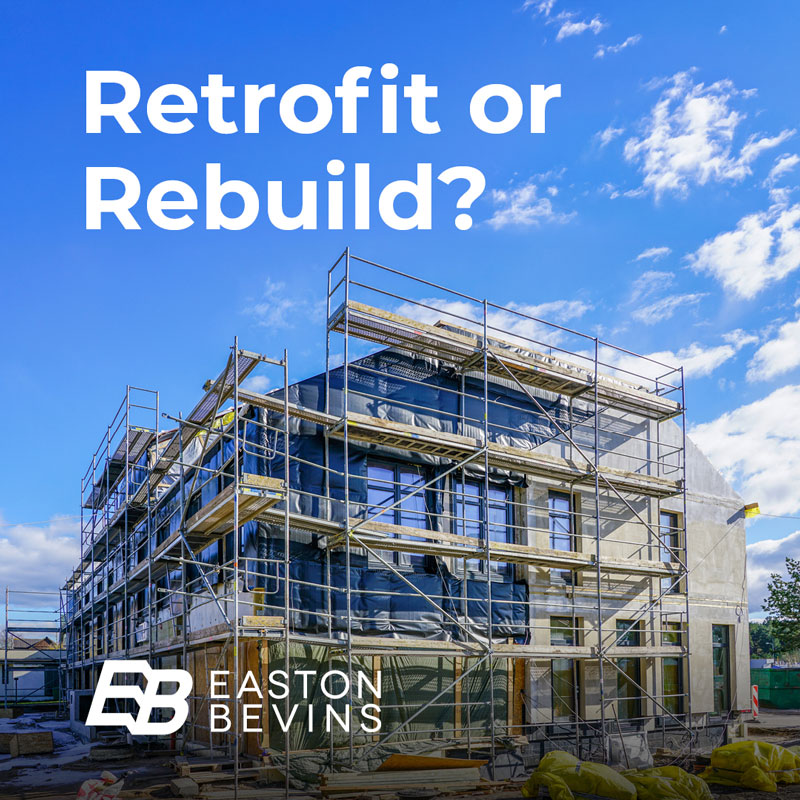
Retrofit or rebuild? The key question facing commercial assets this year
Posted 17 June 2026 By Easton Bevins
Before acquiring land with an existing structure, developers should ask themselves a single crucial question: is it better to retrofit the existing asset or start again with a new build?
Before acquiring land with an existing structure, developers should ask themselves a single crucial question: is it better to retrofit the existing asset or start again with a new build?
It’s a decision that comes with its fair share of consequences, whether that be impacted project costs, altered programme timelines and even brand-new planning considerations. Naturally, every site presents its own opportunities and constraints, making it essential to assess the condition, potential and viability of the existing building before committing to a strategy, trusting an established company like Easton Bevins with your surveying requirements will help you identify any risks.
The growing case for retrofit
As sustainability continues to shape development decisions, retrofit projects have gained significant momentum in recent years.
One of the biggest advantages of retaining an existing structure is the reduction in embodied carbon. By preserving much of the building’s fabric, developers can avoid the environmental impact associated with demolition and the manufacture of new construction materials. For businesses with ESG targets or commitments, this makes a compelling case for refurbishment.
Retrofitting can also help preserve the character of a building. Commercial assets with architectural features, heritage value or a strong local identity often benefit from refurbishment rather than replacement, allowing developers to modernise the asset while retaining the qualities that make it distinctive.
In some instances, retrofit projects may also encounter fewer planning challenges, particularly in conservation areas or where local authorities are keen to preserve existing buildings. Where the structure is fundamentally sound, refurbishment can also shorten construction programmes and bring assets back into use more quickly.
When retrofit becomes more complicated
Despite these benefits, retrofit is not always the most cost-effective or practical solution.
Existing buildings can conceal a range of issues that only emerge during detailed investigations including structural limitations, ageing building services, asbestos, poor energy performance and compliance issues all add significant cost and complexity to a project.
Developers may also find themselves constrained by the existing layout, floor-to-ceiling heights or structural grid, limiting their ability to adapt the building to modern occupier requirements. While a retrofit project may initially appear less expensive than a new build, unforeseen challenges can quickly alter the financial equation when not identified early.
The case for rebuilding
In some situations, demolition and redevelopment remain the strongest commercial option.
A new build provides complete design flexibility, allowing developers to maximise site potential, optimise floor space and create assets that align with current market demands. New developments can also be designed to achieve higher environmental standards, lower operational costs and improved long-term performance.
For sites where value is driven by density, functionality or modern occupier expectations, redevelopment may unlock significantly greater returns than a refurbishment-led approach.
While the upfront investment is often higher, a new build can reduce future maintenance liabilities and provide greater certainty over programme and operational performance.
When rebuild becomes more complicated
While redevelopment can unlock significant value, starting again isn’t always the straightforward solution it appears to be.
Demolition costs, planning delays, environmental considerations and rising construction costs can all impact the viability of a new-build project. In some locations, heritage constraints or local planning policy may make the loss of an existing building difficult to justify, leading to longer approval periods and increased uncertainty.
There is also growing scrutiny around embodied carbon. As sustainability expectations continue to evolve, developers are increasingly required to demonstrate why demolition is necessary and whether retaining part or all of an existing structure would deliver a more sustainable outcome.
For these reasons, a new build should never be viewed as the default option. The commercial, technical and planning implications must be carefully assessed before a redevelopment strategy is adopted.
The importance of early assessment
Ultimately, the decision should never be based solely on construction costs. Developers must weigh up a range of factors, including planning constraints, structural viability, sustainability objectives, programme requirements, lifecycle costs and long-term investment returns.
A building that appears suitable for refurbishment may require extensive intervention once investigations begin. Equally, a site earmarked for demolition may contain valuable structural assets worth retaining.
The most successful projects are those that undertake robust technical and commercial assessments before major decisions are made.
How Easton Bevins can help
At Easton Bevins, we work with developers, investors and asset managers to evaluate the viability of both retrofit and redevelopment strategies.
Through feasibility studies, technical due diligence, structural assessments and cost-risk appraisals, our team helps clients understand the opportunities and constraints associated with each option before significant investment is committed.
Whether the preferred route is refurbishment or complete redevelopment, our focus is always the same: helping clients maximise value, minimise risk and make informed decisions based on sound technical evidence.
There is no universal answer to the retrofit versus rebuild debate. Every building, site and development strategy is different. The key is understanding which approach delivers the best outcome for the asset, both now and in the future.
To learn more, contact us on 0117 942 8776 or email info@eastonbevins.co.uk.
Back to news